
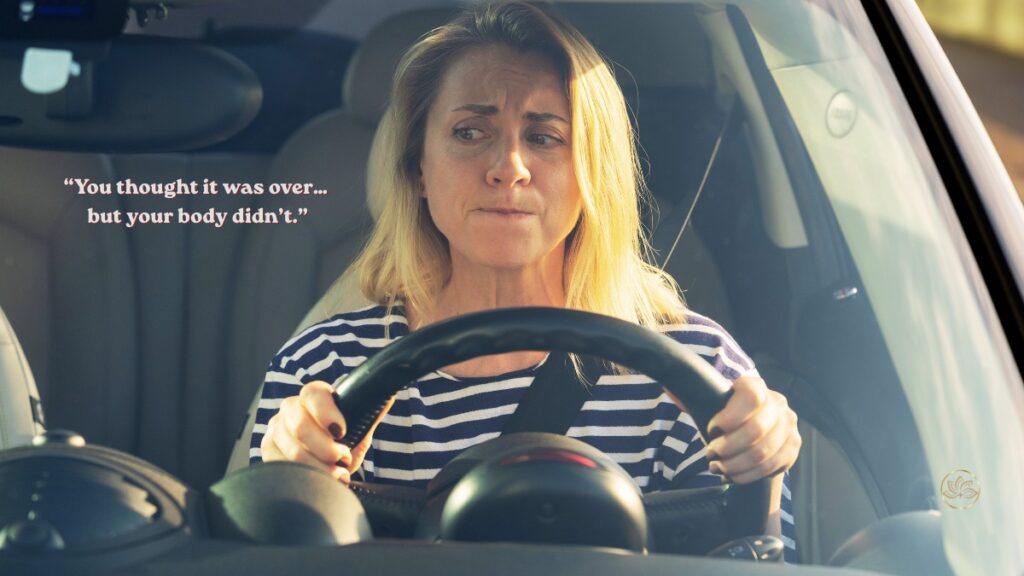
Fear may linger after an auto accident, even when you think you’ve healed. Learn how the body stores trauma—and how to release it.
When the Body Remembers… Even After You Think You’ve Healed
You may tell yourself, “I’m fine now.”
The accident is behind you… and yet you notice a lingering fear of driving after a car accident
You hesitate before getting behind the wheel.
Your body tightens in traffic.
A sudden stop causes your heart to race.
You may even avoid driving altogether, or only drive when necessary. There are even times you begin to doubt and question yourself.
“Why is this still happening?”
The Mind Moves On… But the Body Remembers
After an auto accident, it’s common to focus on physical recovery and the visible aspects of healing. But what often goes unaddressed is how the body stores the experience.
In moments of impact, the nervous system activates a survival response—commonly known as the Fight-or-Flight response. This response is designed to protect you. However, when the body does not fully process and release that response, it can remain “on alert,” even when the danger has passed.
Fear Is Not the Problem—It Is the Signal
What you may be experiencing is not weakness or overreaction.
It is a stored response—held beneath conscious awareness.
This is often described as Somatic memory, where the body retains the emotional imprint of an experience. That imprint can show up as:
- Fear of driving
- Hesitation or avoidance
- Heightened alertness
- Anxiety in traffic
- A sense of unease without a clear reason
Even when, logically, you know you are safe.
Why “Pushing Through” Doesn’t Always Work
Many people try to overcome these feelings by forcing themselves to move forward, telling themselves to “just get over it.” But healing is not a matter of willpower alone.
When the nervous system is involved, the body must feel safe again—not just be told that it is safe.
Until that shift happens, the response continues.
Where True Healing Begins
Healing begins when the body is allowed to release what it has been holding. This is where hypnotherapy can be highly effective.
Rather than working only at the level of conscious thought, hypnotherapy works with the subconscious mind—the place where patterns, responses, and emotional imprints are stored. Through a structured and guided process, the nervous system can recalibrate. And what once triggered fear can begin to feel neutral again.
For Attorneys and Professionals Supporting Clients
If you work with individuals who have experienced auto accidents, you may recognize this pattern: Clients who appear physically recovered… yet continue to struggle with fear, hesitation, or anxiety.
These are not imagined concerns.
They are physiological responses that impact daily functioning and quality of life.
Addressing both the physical and emotional aspects of recovery can support a more complete outcome.
An Invitation
If you are experiencing lingering fear, hesitation, or unease after an accident…
And that is something that can change.
– You are not going backwards.
– You are not failing.
– You are not imagining it either.
Experiencing fear of driving after a car accident is more common than you may think—and it can be addressed.
I invite you to explore what is possible. You may be ready for a different approach. Healing is not about forcing change; it is about allowing your body and mind to come back into alignment. When you are ready, I am here.
A Quick Reminder
Your body is simply asking to complete what was never fully processed.
Schedule a Consultation, let’s talk.